







Share to


Copper prices plummet
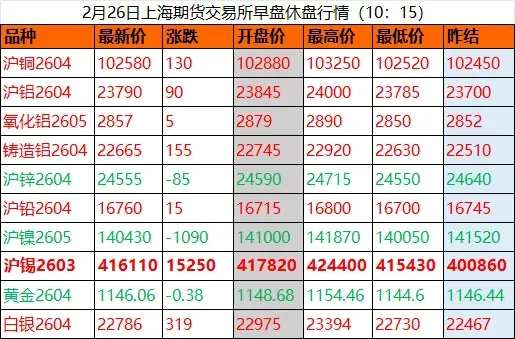
During the weekly trading session in Sanya, London copper opened low and rose before diving again, followed by consolidation at a low level. The latest price was $12767/ton at 10:45 Beijing time, a drop of $13 or 0.10%; In the morning session, Shanghai copper continued its downward trend in the evening session, and the price center has fallen below the important psychological threshold of 100000 rmb. The latest price of the main month 2604 contract at 10:45 was 99200 rmb/ton, a decrease of 860 rmb, a decrease of 0.86%, and hit the lowest point of 98850 rmb/ton during trading.
——March 18 Yangtze River Spot Price Update: Lead ingot #1 surged ahead with a significant rise, reaching a latest price of 16,775 rmb/ton, up 175 rmb;
Copper 1# price was reported at 99,180 rmb/ton, down 1,290 rmb; the premium was 30 rmb/ton, up 10 rmb; aluminum ingot A00 was quoted at 24,510 rmb/ton, down 390 rmb; the discount was 195 rmb; zinc 0# was at 23,210 rmb/ton, down 690 rmb; zinc 1# was at 23,110 rmb/ton, down 690 rmb; nickel 1# was quoted at 138,200 rmb/ton, down 2,050 rmb; tin 1# was at 368,500 rmb/ton, down 12,250 rmb;
1. The "Butterfly Effect" of Geopolitical Conflicts: Copper Prices Caught in the Eye of the Energy Storm
The sharp deterioration of the Middle East situation is spreading "fear premiums" from the energy market to the metals sector. The military standoff between Israel and Iran has led to the de facto closure of the Strait of Hormuz, disrupting 20% of global oil and gas trade. Brent crude oil prices have surged past $103 per barrel, reaching a new high since 2022. The soaring energy prices not only fuel inflation expectations but also trigger deep concerns in the market about global economic "stagflation." Historical data shows that when oil prices exceed $100 per barrel, industrial metal demand often faces pressure due to cost constraints.
Copper, as the "barometer of industrial economy," has become the primary "safety valve" for macro risks. The plunge in LME copper prices during Asian trading hours and the loss of the psychological 100,000-rmb benchmark by the Shanghai copper futures contract reflect the market is pricing response to the dual bearish factors of "demand contraction and cost pressures." Although long-term demand in sectors like AI and new energy remains resilient, short-term sentiment is currently dominated by risk aversion triggered by geopolitical conflicts.
II. The "Dam-Breaking" of Inventory "Reservoirs": 310,000 Tons of Historical Highs Shatter Bullish Confidence
If geopolitical conflicts were the "matchstick" that sparked the decline in copper prices, then the explosive surge in inventories served as the "last straw" that crushed the market. The latest LME data shows that copper inventories surged by 18,800 tons in a single week, reaching 330,400 tons—the highest level since 2019. Behind this figure lies the concentrated eruption of two major contradictions:
The supply side is "undercurrent": as production resumes in major copper-producing countries like Peru and Chile, coupled with the commissioning of new mines in Africa, global copper concentrate supply has shifted from shortage to surplus;
"Soft Reality" on the Demand Side: Domestic real estate investment remains persistently sluggish, while growth in traditional consumption sectors such as home appliances and automobiles has slowed. Downstream enterprises "buy high, not low" mentality has intensified, leading to a concentration of inventory at exchanges.
What is more concerning is that the surge in inventory has triggered a "domino effect" in the spot market: the premium for spot copper on the Yangtze River has narrowed to 50 rmb/ton, down 70% from the beginning of the year; the futures curve has shifted from "deep backwardation" to "flattening," indicating heightened market expectations of short-term supply-demand imbalances.
III. The Fed is "Interest Rate Cut Uncertainty": A New Variable in the Copper Price Bullish-Bearish Battle
Beyond geopolitical conflicts and inventory surges, the upcoming Federal Reserve interest rate decision this week is emerging as the "third factor" driving copper price volatility. Market consensus anticipates that a "delayed rate cut" signal from the Fed could strengthen the U.S. dollar index, further suppressing dollar-denominated copper prices. Conversely, heightened expectations for rate cuts might alleviate macroeconomic pressures and provide short-term support for copper prices.
However, regardless of the Federal Reserve is decision, the medium-term trend of copper prices still hinges on two core factors:
The persistence of geopolitical conflicts: If the Strait of Hormuz remains closed for an extended period, the energy crisis will escalate into a global supply chain crisis, and copper prices may plummet due to the dual pressures of "cost-driven and demand collapse.";
China is "Counter-Cyclical Adjustment" Demand: As the world is largest copper consumer, whether China is "14th Five-Year Plan" manufacturing support policies (such as optimizing tax refund procedures and addressing deduction gaps) can offset the downward pressure from the real estate sector will be a key variable determining the bottom of copper prices.
IV. Technical Aspects and Trading Recommendations: 98,000 rmb as the "life-and-death line"
From a technical perspective, the main Shanghai copper futures contract has fallen below the psychological barrier of 100,000 rmb, with the support level shifting lower to 98,000 rmb/ton (near the annual moving average). If the geopolitical conflict continues to escalate or inventory accumulation persists, copper prices may decline further to the 95,000 rmb range. Conversely, if expectations for Federal Reserve rate cuts strengthen or domestic consumption shows seasonal recovery, prices could rebound to around 102,000 rmb.
Operation Strategy:
Short term (within 1 week): Approach with a volatile bearish mindset, test short positions with a light position of 100200 rmb, and set stop loss at 101000 rmb;
Mid term (1 month): Pay attention to the effectiveness of the support of 98000 rmb. If it falls below the effective level, it may open a new downward channel;
Risk points: sudden easing of geopolitical conflicts, China is large-scale stimulus policies, and unexpected depletion of LME inventories.
Conclusion: Copper Price Seeks Balance in the "Eye of the Storm"
The current copper market is facing triple impacts of geopolitical conflicts, inventory surges, and policy variables, with significantly increased price volatility. For investors, instead of predicting whether there will be a deep decline, it is better to focus on three major signals: the passage status of the Strait of Hormuz, the growth rate of China is power grid investment, and the outflow rhythm of LME warehouse receipts. In the tug of war between macro and micro, copper prices may undergo a value reassessment through a "three in, two out" approach, and the 98000 rmb mark will become a "touchstone" to test bullish confidence.
Disclaimer: The views expressed in this article represent personal opinions only and are not recommended. The trading guidelines are based on this and the risks are borne by the individual.
Source: Changjiang Nonferrous Metals Network






 Home
Home
 Tel
Tel Email
Email Message
 Contact