






Share to


Tin prices lead the market, while copper prices diverge between futures and spot
Early session futures market closure:
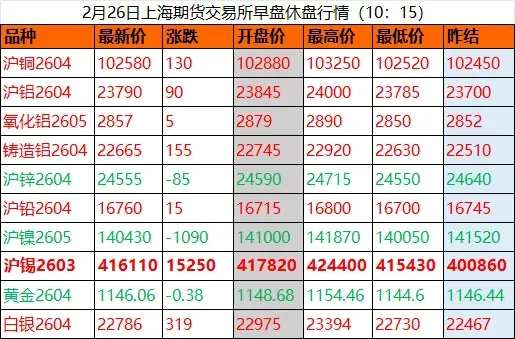
——February 26, 2024 Yangtze River Spot Price Update:
Tin No.1 continued to lead the non-ferrous metals sector, with the latest price at 415,250 yuan/ton, up 11,500 yuan; copper No.1 was quoted at 102,130 yuan/ton, down 100 yuan; the discount stood at 100 yuan/ton, down 10 yuan; aluminum ingot A00 was priced at 23,520 yuan/ton, up 140 yuan; the discount was at 175 yuan; zinc No.0 was quoted at 24,490 yuan/ton, down 80 yuan; zinc No.1 was priced at 24,390 yuan/ton, down 80 yuan; lead ingot No.1 was quoted at 16,775 yuan/ton, up 25 yuan; nickel No.1 was priced at 144,200 yuan/ton, down 1,250 yuan;
In the current era of macroeconomic changes and geopolitical undercurrents, the non-ferrous metal market is like a turbulent river, with major varieties such as copper, aluminum, zinc, lead, nickel, and tin like heroes, performing their own ups and downs in the fierce confrontation between long and short forces. What kind of waves will these metal varieties create in this market this morning? Let's clear the fog together and gain insight into the opportunities ahead.
Copper: A "Showdown" Between Macro Favorability and Inventory Pressure
On the macro level, the U.S. Supreme Court ruled that certain tariffs were invalid, which once brought a glimmer of hope, filling the market with optimism about global economic growth and metal consumption prospects. However, Trump is remarks about raising global tariffs struck like a heavy blow, casting a thick shadow over the market. Yet, the strong rally in global stock markets, particularly the leading performance of U.S. tech stocks, acted as a shot in the arm, boosting expectations for AI development prospects and building a solid defense for copper prices. The People is Bank of China is reverse repo operation and Shanghai is new real estate policy, the "Seven Measures," signaled policy support, leading to relatively loose market liquidity. The market widely anticipates a moderate recovery in copper demand driven by the resumption of infrastructure and real estate projects after the holiday.
On the fundamental front, disturbances in global major mining operations persist, with copper concentrate spot processing fees continuing to decline, serving as a mirror that clearly reflects the reality of tight supplies. The robust structural support for copper prices remains intact. However, global copper inventories continue to rise, while spot-side consumption remains sluggish and trading activity is subdued, akin to a heavy boulder that exerts strong pressure on the upward trajectory of copper prices. As the end of February approaches, the traditional peak season for the industry is imminent, with the market brimming with optimistic expectations for the "Golden March and Silver April." Coupled with the dominant influence of macroeconomic expectations, copper prices are expected to maintain a high and strong fluctuation in the short term. Future developments will require close monitoring of global mine production resumption, inventory changes, and adjustments in macroeconomic policies.
Aluminum: "Intense Struggle" Between Supply Pressure and Demand Expectations
Macroscopically, the interplay of U.S. tariffs, high inflation, and geopolitical tensions collectively shapes market dynamics. Gold prices have strengthened, while the base metals sector remains robust, with Shanghai aluminum rebounding on this momentum. Market concerns over U.S. tariffs and the economy have eased overall, leading to dollar volatility and a weakening trend. U.S. tech stocks led the gains, and overseas risk appetite improved, fostering a favorable environment for the base metals sector is strength. Signals of "policy easing" in China is real estate market, along with further relaxations in Shanghai is "Seven Measures" easing home purchase restrictions for non-local residents, were interpreted by the market as potential benefits for metal consumption. There is widespread expectation that post-holiday infrastructure and real estate sector resumption will drive a moderate recovery in aluminum demand.
In terms of fundamentals, domestic electrolytic aluminum production capacity remains high with limited incremental growth, resulting in relatively low supply pressure. Overseas supply faces uncertainty, as shutdowns and restarts of smelters intertwine like a mist, making market movements difficult to predict. On the demand side, the aluminum industry has not fully recovered from production halts, with low operating rates across downstream sectors and weak spot trading activity. The expected accumulation of social inventories for aluminum ingots casts a shadow over prices, exerting some downward pressure. However, the long-term positive outlook remains unchanged, and with market traders optimistic about future price trends, the high-level aluminum price rally is expected to persist. Today, spot aluminum prices may strengthen. Going forward, attention should be paid to overseas supply changes, the pace of domestic demand recovery, and the impact of macroeconomic policies on the market.
Tin: A "comeback king" of strong rebound due to supply-demand mismatch
On the macro front, the domestic metal market remained strong after the Spring Festival, driven by multiple factors leading to a broad-based rally. The weakening U.S. dollar and volatility in the U.S. stock market prompted capital to shift toward commodities. The hardwareization of AI and the transition to new energy boosted demand for metals, while key resource export policies and geopolitical factors drove up supply chain security premiums, pushing tin prices higher.
Currently, the upward trend in tin prices is strongly supported by short-term supply-demand dynamics, characterized by a mismatch of "tight supply and recovering demand." On the supply side, domestic smelters underwent maintenance during the Spring Festival, while constraints on global major production regions persisted, limiting the increase in smelting operating rates. On the demand side, traditional consumption rebounded moderately, while emerging sectors such as new energy vehicles, AI computing infrastructure, and photovoltaics showed robust growth, becoming the core drivers for absorbing incremental tin supply. In the short term, tin prices are expected to continue a strong rebound but with a slowing pace and high-range fluctuations, with the primary Shanghai tin futures contract trading within a range of 415,000 to 428,000 yuan/ton. Key factors to monitor in the future include smelter resumption progress, downstream order sustainability, and macroeconomic sentiment fluctuations.
Zinc: A "Foggy Journey" of Complex Sentiment and Short-Term Volatility
The stock market is strong, the US dollar is weak, and oil prices are fluctuating. Overnight, London zinc fell by 0.01% alone, like being silent in a noisy environment. At the macro level, the uncertainty surrounding Trump is tariff policy continues to ferment. Despite the Supreme Court ruling that some tariffs are illegal, the market still has concerns about the refund process. However, the high decline of the US dollar index indirectly pushed up zinc prices. Concerns about the impact of AI technology have eased, and risk appetite in global stock and commodity markets has rebounded. Shanghai is "Shanghai Seven Measures" have released policy support signals, and the market generally expects that the resumption of construction and real estate chain work after the holiday will drive a moderate recovery in metal demand.
In terms of fundamentals, after the Spring Festival, funds have not fully flowed back, market liquidity is tight, zinc consumption is weak, and transactions are low. The Shanghai Zinc Society continues to accumulate pressure on zinc prices, like a heavy shackle, restricting the rise of zinc prices. But the zinc ore import window is closed, and domestic northern mines will resume work comprehensively from April to May. The current zinc ore processing fee is expected to remain low, coupled with the disturbance of Iran is zinc ore supply and inventory, the cost side forms support, like a glimmer of hope in the darkness. Short term zinc prices follow the strong oscillation of the non-ferrous sector, and today is zinc market trend is expected to weaken. Pay attention to the 24400 yuan/ton below. In the future, it is necessary to closely monitor the recovery of consumption, changes in zinc ore supply, and the direction of macroeconomic policies.
Lead: Supply and demand support, steady pace of slight increase
Macroscopically, global trade policies and geopolitical uncertainties strengthen the strategic reserves and anti inflation value of lead. The market is expectation of a shift in global liquidity continues, with lower real interest rates supporting commodity valuations. Tin and aluminum in the non-ferrous metal sector have shown strong performance, forming a linkage effect to drive the passive strengthening of lead prices. With the joint efforts of domestic and international environments, the central bank in China maintains loose liquidity and accelerates the resumption of work and production after the holiday; Overseas LME non-ferrous metals generally rose, the US dollar index fell, and the risk appetite of the US stock market rebounded, attracting funds to allocate to metal varieties.
There is a significant contraction in the supply side, with low operating rates of primary lead due to Spring Festival maintenance, delayed resumption of production of recycled lead due to losses and environmental constraints, and low processing fees for lead concentrate, resulting in tight supply to support lead prices. The demand side recovery has a rhythm, and lead-acid battery companies resume work earlier than the supply of recycled lead after the holiday, forming a temporary supply-demand gap and accelerating inventory digestion. It is expected that the lead price will continue to rise slightly on the same day, and the increase may narrow, showing a trend of "high opening, high going, and fluctuating ending". The main contract price range for Shanghai lead is 16650-16900 yuan/ton. Focus on risks such as the rebound of the US dollar index, the resumption of production of recycled lead, and downstream demand for battery procurement in the future market.
Nickel: a dance of balance with mixed long and short positions and range oscillations
On a macro level, key international negotiations in Geneva and the Red Sea shipping crisis have boosted risk aversion, while domestic policies have focused on strengthening the foundation of economic recovery. Nonferrous metals, which have both industrial and financial attributes, are receiving attention from funds. Overnight, London nickel rose sharply before taking profits and fluctuating downwards, with a high probability of a significant correction in this trading day.
On the supply and demand side, the contraction of supply resonates with the structural recovery of demand. On the supply side, Indonesia has significantly reduced its nickel ore production quota, while the Philippines' exports have slowed down during the rainy season, strengthening expectations of tight supply. On the demand side, the improvement in profits in the stainless steel industry has driven inventory replenishment, while the growth in production and sales of new energy vehicles and the high nickel conversion of ternary batteries have boosted demand for nickel sulfate. The market is actively purchasing at low prices, and spot prices are rising. In the short term, nickel prices will fluctuate within a range, and the subsequent trend depends on the implementation of quotas in Indonesia, the recovery of supply in the Philippines, and the improvement of downstream demand. Observe the effectiveness of 140000 supports below.
Overall, non-ferrous metals such as copper, aluminum, zinc, lead, nickel, tin, etc. have different trends under the influence of multiple factors such as macro situation, fundamental supply and demand, like a wonderful and diverse drama in the martial arts world. In the future, investors need to closely monitor macroeconomic policy adjustments, changes in geopolitical situations, supply and demand dynamics, and market capital flows. With keen insight and decisive decision-making power, they should seek investment opportunities in this turbulent metal market and be proud of the river and lake.
Disclaimer: The views expressed in this article represent personal opinions only and are not recommended. The trading guidelines are based on this and the risks are borne by the individual.
Source: Changjiang Nonferrous Metals Network






 Home
Home
 Tel
Tel Email
Email Message
 Contact