





Share to


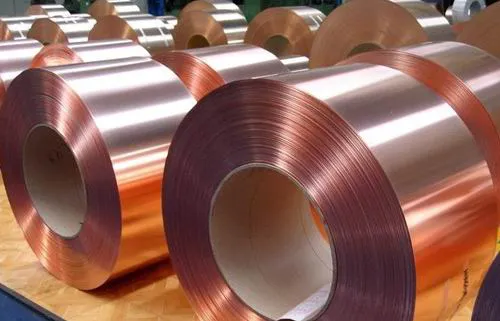
Copper transformer belts are key materials in power transformers, and their quality is directly related to the efficiency and reliability of the transformer. Below I will introduce you to the production process and quality control of copper transformer belts.
1. Main production process
The production process of copper transformer belts is complex and requires careful control of each link.
1、 Smelting casting: The primary goal of this link is to prevent the molten copper liquid from getting inhaled (mainly hydrogen and oxygen), which will reduce the performance of the copper. High-quality cathode copper raw materials are required and deoxygenated using phosphorus copper intermediate alloy. Strictly control the residual amount of phosphorus (usually required ≤0.001%), Although phosphorus can effectively deoxygenate, it will significantly reduce the conductivity of copper. The smelting process needs to be carried out under a sealed environment or a protective atmosphere (such as charcoal cover) to reduce contact between copper and air. When casting, large ingots (some weighing up to 25 tons) usually adopt semi-continuous or fully continuous casting.
2、 Hot rolling: Hot rolling is carried out after heating the ingot. The heating temperature is usually controlled at 850-920 ℃, A neutral or microreducible atmosphere is used to prevent oxidation and "hydrogen embrittlement". Hot rolling billet temperature is higher than 820 ℃, Final rolling temperature shall not be less than 600 ℃. Hot rolling can roll ingots into thicknesses of 14-16 mm .
3、 Milling surface: There will be oxides and defects on the surface of the strip after hot rolling, and it needs to be removed through the milling surface process to ensure that the surface of the strip is smooth and the thickness is uniform.
4、 Cold rolling: The strip blank after the milling surface is cold rolled on a modern rolling mill equipped with a thickness automatic control system to achieve the required thickness and accuracy. This process requires control of the shape and surface quality of the board.
5、 Annealing: Annealing is a key process that determines the performance of the finished product (soft state, hard state, etc.). Cover annealing furnace or continuous bright annealing furnace can be used. Continuous bright annealing can better ensure uniform performance and bright surface.
6、 Finished shearing and edge treatment: The transformer copper belt has high requirements for edge burrs, because the burrs may pierce the insulating layer or cause discharge. Precision longitudinal slicing is required through disc shears, and process parameters such as shear blade clearance and overlap amount are strictly controlled. For products with higher quality requirements, chamfering (rounded corners) or rounded edges are also required. Common methods include scraping, milling or rolling (such as the "Trinity Rolling Method").
7、 Packaging and transportation: The finished copper belt is heavy, the edges are prone to damage, and the surface is prone to discoloration due to environmental reasons. Appropriate packaging and transportation methods are required to protect the product.
2. Key quality control points
The quality control of copper transformer belts runs throughout the entire production process. Here are some key control points:
1、 Chemical composition: Strictly monitor the content of impurities, especially phosphorus ( P) and oxygen ( O). Phosphorus residues are usually required to be no more than 0.001% to ensure high conductivity. Sometimes iron control is also required ( Fe) etc.
2、 Mechanical properties: including tensile strength, elongation after break, Vickers hardness, etc., must comply with the standards (such as GB/T18813) or requested by the customer.
3、 Electrical performance: Conductivity is a key indicator, usually required to be no less than 98%. IACS( International Annealed Copper Standard), even higher. The conductivity difference between coils also needs to be controlled (such as the difference is no more than 1% IACS)。
4、 Dimension and appearance accuracy:
Thickness and width tolerance: Must comply with the standards.
Edge burrs: There are strict restrictions, such as thickness ≥0.4mm The edge burrs of the strip are not greater than 0.05 mm; thickness <0.4mm The burr of the strip is not greater than 0.03 mm. Product requirements may vary from width and thickness.
Side curvature: should not be greater than 2 mm/m。
Edge shape: It must meet the requirements of shearing edges, rounded corners or round edges, and there should be no sharp corners, rough or convex edges.
5、 Surface quality: The strip must have a straight plate shape, smooth and clean surface, and no defects such as cracks, folding, inclusions, oxidation, discoloration, etc.
6、 Microstructure and performance uniformity: By controlling the processing rate and annealing process, ensure that microstructures such as grain size meet the requirements and uniform performance.
3. Standards and specifications to follow
Domestic production of copper transformer belts mainly comply with national standards GB/T18813《 Transformer Copper Belt》. This standard specifies the technical requirements, testing methods, inspection rules and packaging, marking, transportation, storage and other requirements of the product. The new version is GB/T18813-2014, Replaced the 2002 edition. In addition, it may also be referenced to industry standards, enterprise standards or specific user requirements.
4. Summary and Outlook
The production of copper transformer belts is a precision technology integrating metallurgy, materials and mechanical processing. It has a long process and a wide range of control points. From the purity control of melt casting, to the molding and dimensional accuracy control of hot rolling and cold rolling, to the performance control of annealing, as well as precision shearing and edge processing, every step is crucial.
As transformers develop towards large capacity, high efficiency, high reliability and miniaturization, higher requirements are also put forward for copper transformer belts, such as lower losses, higher conductivity, better mechanical strength and more accurate dimensional control. This will be a continuous challenge and driving force for the raw material purity, production process stability and quality control methods of copper belts.






 Home
Home
 Tel
Tel Email
Email Message
 Contact